
From Knowledge to Change: How People Actually Learn?

How do people actually learn?

Today, few people still believe that simply “transferring knowledge” is enough for real learning to happen. In practice, we have long known that a high-quality training experience involves participant engagement, discussion, exercises, and the exchange of experiences. Active learning is no longer a novelty – it has become the standard.

Despite this, the gap between trainings and lectures that truly influence how people think and work, and those that merely provide a good experience without long-term impact, remains significant. The reason for this is usually not the content itself, nor the intention behind it. More often, it lies in how much the learning process is actually grounded in the principles of how people learn – or how much we refer to those principles only declaratively.

Because participating in an activity is not the same as truly learning through it. Understanding an idea in the moment is not the same as being able to apply it later, in a real-life situation.

This distinction becomes clearer when we look at how we are used to learning. In many education systems, the focus is still on memorization, repetition, and reproduction of information. While often criticized, this approach does have its place – without a certain foundation of knowledge, it is difficult to make connections, draw conclusions, and develop deeper understanding.

However, the problem arises when learning stops there. Information that is merely memorized often remains fragile – it fades quickly if it is not used, connected, and given personal meaning. For knowledge to become lasting and applicable, more is required than memorization: it needs to be processed actively – questioned, connected, applied, and tested across different situations.

This is why the way the learning process is designed becomes more important than the content itself. What matters is not what is covered in a training, but what participants actually do with that content while learning. In the space between information and application lies the essence – the place where knowledge is not transferred but constructed.

And it is precisely the understanding of this process that makes the difference between training that remains at the level of a well-delivered lecture and training that truly changes how people work.

What happens in the brain when we learn?

For a long time, learning was viewed as a process in which a person receives information, stores it, and later reproduces it. Today, we know that the reality is far more complex. Research in cognitive psychology and neuroscience shows that the brain is not a passive storage space for information. Learning is an active process in which we connect new ideas with existing knowledge, experiences, and prior conclusions.

This is why simply listening is not enough.

For new information to become lasting knowledge, the brain needs to process it, connect it with what it already knows, and make sense of it. The more we engage with an idea – by asking questions, analysing it, and using it in different situations – the more likely we are to understand it, remember it, and apply it later.

In other words, people do not learn most effectively when they receive information. They learn when they do something with it.

Why do we remember better what we generate ourselves?

One of the most interesting findings in memory research is known as the generation effect. It shows that people remember information much better when they arrive at it through their own thinking, compared to information they simply read or hear.

When a trainer asks a question, presents a problem, or invites participants to come up with a solution, the brain invests additional mental effort. This effort strengthens memory connections and deepens understanding. That is why a well-posed question often has more value than a ready-made answer.

The same principle explains why case studies, group discussions, brainstorming sessions, problem-solving tasks, and practical exercises are so effective. Their purpose is not only to engage participants, but to activate processes that are scientifically proven to support learning.

Why do we remember experiences best?

Think about the last time you truly learned something important. There is a good chance that it was not when you read a definition or looked at a slide.

More likely, it was when you tried something, made a mistake, talked it through with others, made a decision, or experienced a situation that had personal meaning for you.

The brain remembers information much more easily when it is connected to experience and emotion – when it carries personal significance. When we participate in a simulation, resolve a conflict, have a client conversation, or analyse a real business challenge, much more is activated than simple recall. Attention, emotions, decision-making, and prior experience all become part of the process.

That is why most people will remember a well-designed exercise much longer than a presentation they watched for ten minutes. This is also one of the key reasons why experiential methods have become standard in modern corporate learning.
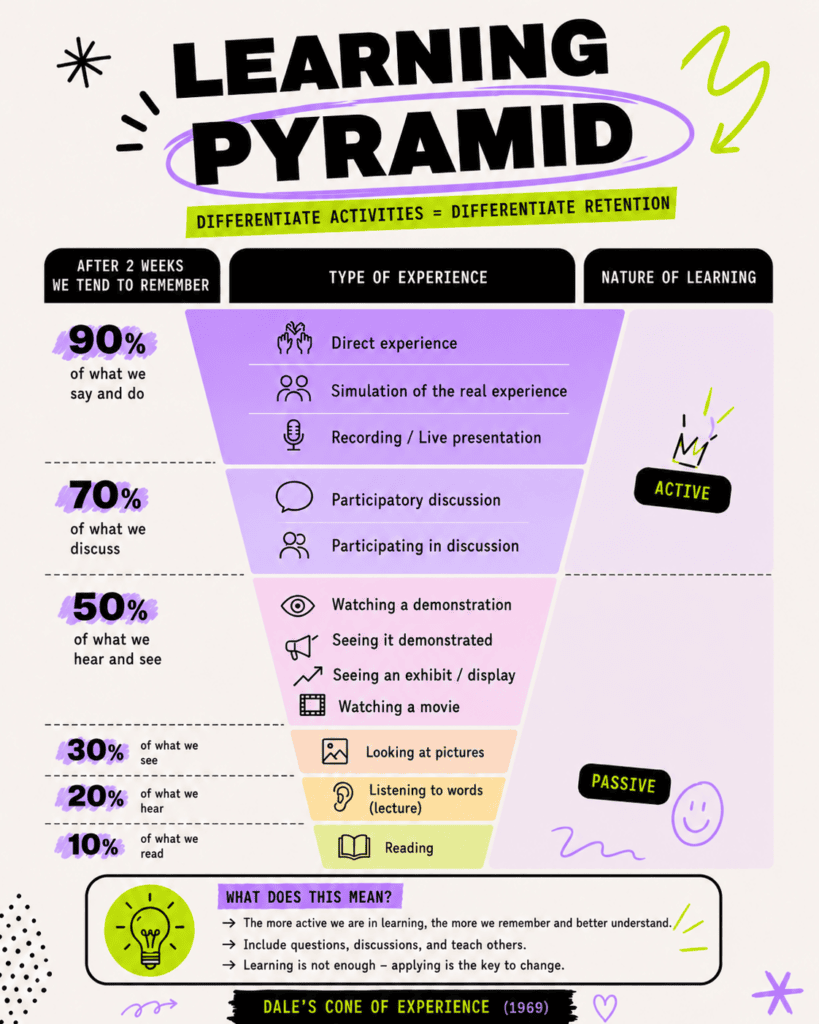
Why are exercises a core part of training?

Once we understand how people learn, it becomes clear that exercises are not a break between theoretical segments.

They are where learning actually happens.

It is only when we try to apply new knowledge that we truly see what we understand, where gaps exist, and which skills need further development. Simulations, role-plays, case studies, and discussions provide a space to experiment, make mistakes, and receive feedback in a safe environment – before facing real and more demanding business situations.

This is especially important when developing skills such as communication, leadership, negotiation, sales, or organization. These skills cannot be developed through listening alone. Just as no one can learn to drive by watching a presentation on traffic rules, business skills cannot be developed without active practice.

From learning to change

The ultimate goal of any training is not for participants to know more, but to do things differently.

Organizations do not invest in employee development so that people can memorize more facts, but because they want better communication, stronger leadership, more effective collaboration, improved problem-solving, and better business results.

The more a training is connected to real challenges participants face, and the more opportunities it provides for active application of knowledge, the more likely it is that learning will transfer into everyday work.

That is why a high-quality training is not the one where participants sit and listen. It is the one where they think, discuss, question, practice, and experiment.

Because people rarely remember what they have only heard – they remember what they have understood, experienced, and turned into their own knowledge.

From Knowledge to Change: How People Actually Learn?

How do people actually learn?

Today, few people still believe that simply “transferring knowledge” is enough for real learning to happen. In practice, we have long known that a high-quality training experience involves participant engagement, discussion, exercises, and the exchange of experiences. Active learning is no longer a novelty – it has become the standard.

Despite this, the gap between trainings and lectures that truly influence how people think and work, and those that merely provide a good experience without long-term impact, remains significant. The reason for this is usually not the content itself, nor the intention behind it. More often, it lies in how much the learning process is actually grounded in the principles of how people learn – or how much we refer to those principles only declaratively.

Because participating in an activity is not the same as truly learning through it. Understanding an idea in the moment is not the same as being able to apply it later, in a real-life situation.

This distinction becomes clearer when we look at how we are used to learning. In many education systems, the focus is still on memorization, repetition, and reproduction of information. While often criticized, this approach does have its place – without a certain foundation of knowledge, it is difficult to make connections, draw conclusions, and develop deeper understanding.

However, the problem arises when learning stops there. Information that is merely memorized often remains fragile – it fades quickly if it is not used, connected, and given personal meaning. For knowledge to become lasting and applicable, more is required than memorization: it needs to be processed actively – questioned, connected, applied, and tested across different situations.

This is why the way the learning process is designed becomes more important than the content itself. What matters is not what is covered in a training, but what participants actually do with that content while learning. In the space between information and application lies the essence – the place where knowledge is not transferred but constructed.

And it is precisely the understanding of this process that makes the difference between training that remains at the level of a well-delivered lecture and training that truly changes how people work.

What happens in the brain when we learn?

For a long time, learning was viewed as a process in which a person receives information, stores it, and later reproduces it. Today, we know that the reality is far more complex. Research in cognitive psychology and neuroscience shows that the brain is not a passive storage space for information. Learning is an active process in which we connect new ideas with existing knowledge, experiences, and prior conclusions.

This is why simply listening is not enough.

For new information to become lasting knowledge, the brain needs to process it, connect it with what it already knows, and make sense of it. The more we engage with an idea – by asking questions, analysing it, and using it in different situations – the more likely we are to understand it, remember it, and apply it later.

In other words, people do not learn most effectively when they receive information. They learn when they do something with it.

Why do we remember better what we generate ourselves?

One of the most interesting findings in memory research is known as the generation effect. It shows that people remember information much better when they arrive at it through their own thinking, compared to information they simply read or hear.

When a trainer asks a question, presents a problem, or invites participants to come up with a solution, the brain invests additional mental effort. This effort strengthens memory connections and deepens understanding. That is why a well-posed question often has more value than a ready-made answer.

The same principle explains why case studies, group discussions, brainstorming sessions, problem-solving tasks, and practical exercises are so effective. Their purpose is not only to engage participants, but to activate processes that are scientifically proven to support learning.

Why do we remember experiences best?

Think about the last time you truly learned something important. There is a good chance that it was not when you read a definition or looked at a slide.

More likely, it was when you tried something, made a mistake, talked it through with others, made a decision, or experienced a situation that had personal meaning for you.

The brain remembers information much more easily when it is connected to experience and emotion – when it carries personal significance. When we participate in a simulation, resolve a conflict, have a client conversation, or analyse a real business challenge, much more is activated than simple recall. Attention, emotions, decision-making, and prior experience all become part of the process.

That is why most people will remember a well-designed exercise much longer than a presentation they watched for ten minutes. This is also one of the key reasons why experiential methods have become standard in modern corporate learning.

Why are exercises a core part of training?

Once we understand how people learn, it becomes clear that exercises are not a break between theoretical segments.

They are where learning actually happens.

It is only when we try to apply new knowledge that we truly see what we understand, where gaps exist, and which skills need further development. Simulations, role-plays, case studies, and discussions provide a space to experiment, make mistakes, and receive feedback in a safe environment – before facing real and more demanding business situations.

This is especially important when developing skills such as communication, leadership, negotiation, sales, or organization. These skills cannot be developed through listening alone. Just as no one can learn to drive by watching a presentation on traffic rules, business skills cannot be developed without active practice.

From learning to change

The ultimate goal of any training is not for participants to know more, but to do things differently.

Organizations do not invest in employee development so that people can memorize more facts, but because they want better communication, stronger leadership, more effective collaboration, improved problem-solving, and better business results.

The more a training is connected to real challenges participants face, and the more opportunities it provides for active application of knowledge, the more likely it is that learning will transfer into everyday work.

That is why a high-quality training is not the one where participants sit and listen. It is the one where they think, discuss, question, practice, and experiment.

Because people rarely remember what they have only heard – they remember what they have understood, experienced, and turned into their own knowledge.

People & Culture Leaders, Is the Hunt for New Tech Wearing You Out?

New technologies surround us more and more every day. From collaboration platforms to VR training solutions and productivity apps, the market offers something new almost every week.

For professionals, especially those of us who are tech oriented, the constant push to “stay ahead” can be exciting. The appeal is clear. Innovative tools promise speed, efficiency and better outcomes. If you like having things under control, they can look like the perfect solution to every operational challenge. A platform for better team communication, an app for organizing tasks, a tool for scheduling meetings – just name it and technology will deliver.

Early adopters often gain a competitive edge, along with special discounts and VIP treatment from providers. There is also no denying that exploring new tools can spark fresh ideas and improve problem solving.

But there is a hidden cost to constant exploration. Testing and onboarding new solutions takes time away from core work. The so-called “shiny object syndrome”  means hopping from one tool to another without ever fully using any of them, and it can quietly erode productivity. With every new demo, article or LinkedIn post about the next big thing, information overload builds up and decision fatigue sets in.

When inputs become overwhelming, curiosity can quickly turn into pressure, and pressure into burnout. The result may be the exact opposite of what you hoped for, creating what many call the productivity paradox. The more tools you add, the harder it becomes to keep your workflow cohesive. Switching comes with its own costs such as new learning curves, migrating data and adapting processes again. Sometimes the promised efficiency gains never actually appear.

Some technologies, however, are designed to address very specific needs with clear and measurable benefits. For example, digital platforms that streamline background and reference checks can significantly reduce the time HR teams spend chasing referees and checking candidates’ references, allowing them to focus on the human side of hiring.

Other innovations open entirely new possibilities for learning and development. Immersive VR training solutions for onboarding and safety enable employees to practice skills in realistic but risk-free environments, making preparation both engaging and effective.

To take the best from technological advancements while still satisfying your curiosity, it is important to find a healthy balance. Before adopting something new, ask yourself what problem it really solves. If you already have three solutions for the same issue, it may be worth waiting. Being an early adopter is a mindset, but if it costs you time and energy you do not have, it may be time to change your approach. Keep your core toolkit stable and leave space for controlled experimentation only when it makes strategic sense.

The most important step is to shift from FOMO to focus. Accept that you cannot try every new technology. Instead, give your attention to those that align with your goals and values. If you are leading a team or an organization, create a culture where adoption is intentional, not reactive, and where both risks and benefits are carefully considered.

Exploring new technologies should be energizing, not exhausting. With the right boundaries and priorities in place, you can stay innovative without draining your time, energy or attention and let technology truly serve you rather than the other way around.

If you are not in that boat yet, enjoy the slower pace while it lasts, but be mindful not to be swept away when you do step in. This is especially true for tech-savvy HR professionals and business leaders who like to stay on top of every trend. The future is here, so be present and take advantage of it strategically.

Feedback as the key to successful communication

Date: November 26th, 2020 from 18-20h

Location: Zoom online

Nowadays, feedback is considered an indispensable element of successful communication – with its help we gain insight into our behaviour, performance and if we use it in a good way, it can certainly help us in further progress and personal development.

We are often overwhelmed by content that teaches us how to successfully give feedback, and we unfairly neglect the importance of receiving feedback, in which lies all the power of change and further progress. And so, in this workshop, in addition to learning how to give feedback, we will also deal with receiving feedback and we will try to understand why it is sometimes difficult for us to ask for it and how we can overcome that.

What will you learn?

  • Why is feedback useful and what types of feedback exist?
  • How to give feedback through the SBI model?
  • What prevents us from seeking feedback in everyday life?
  • What is a feedback matrix?
  • Why feedback can be difficult?

Who is this training for?

To all of you who want to improve your skills of giving and receiving feedback. To you who often stop before you want to give someone feedback because you are not sure how to say it, as well as to you who refrain from asking for feedback because you are afraid of what you will hear. Come to talk about it and to share different experiences!

Facilitator

Iva Miljić, Learning and Development Consultant

Iva is a master clinical psychologist who started her career working with UNICEF and providing psychological support to children and adults affected by major floods in 2014. For the last 4 years she has been working in the HR agency Jaka Lounge, where, among other things, she deals with the development and delivery of trainings for various business clients. Her focus is on New Leaders training, as well as on soft skills trainings.

The training is free, but registration is required at info@jakalounge.com with your name, surname and the role you are currently in.

Number of participants is limited.

For additional details call +381 69 27 47 848

Stress Management Online Training

Date: September 30th, 2020 from 11-13h
Location: Zoom online

Different life circumstances and unexpected events can lead to stress, and potentially health problems and daily functioning. Most of us are taught to fight stress and use different strategies to reduce stress, but what if we’ve been taught wrong? What if we’re not supposed to fight stress, just to better understand it? What if the stress itself was never a problem, but our attitude towards it?

What will you learn?

• How do Harvard researchers look at stress and what do the latest studies in this field tell us?
• What is the paradox of stress?
• Can we change our physiology with the help of proper mindset and how is it related to stress?
• How the development of WhatsApp, Instagram and the electron microscope is linked to stress?

We hope that with this training you will:

• Understand stress better and learn to accept it, not run away from it
• Use stress to your advantage
• Learn to stress better 😊

Who is this training for?

Everyone! To those of you who are currently stressed, those of you who were stressed until yesterday, but want to learn how not to be tomorrow, as well as those of you who are waiting for an important project in December that you are already stressed out about! 😊

Facilitator

Iva Miljić, Learning and Development Consultant

Free registration, number of participants limited

Call and find out more details +381 69 27 47 848

You can send your application to info@jakalounge.com

New Leaders Training – The Mindset of A Leader

Date: February 28th, 2020 from 09.00AM until 05.00PM

Location: Jaka Lounge, 44 Niška, Vračar, Belgrade (entrance from Loznička street, 1st floor)

What will you learn?

  • How do adults learn, and why is understanding of the learning process essential for every leader?
  • How do we perceive our habits and are they restraint or an incentive for team leading?
  • Are you able to perceive yourself objectively as a leader and are you prepared to change?
  • What is leader’s mindset and how does it look like for a top performer?
  • About emotions and behavior and how they affect your performance
  • What is your business approach and how does it affect your team leading?

Who is this training for?

The training is primarily intended for new leaders who have recently taken over or plan to take over the responsibility of leading a team, but also for those who would like to improve their leadership skills.

Facilitator

Iva Miljić, Learning and Development Consultant

Early registration fee until February 20th: 240EUR + VAT

Registration fee after February 21st: 300EUR + VAT

Call and find out more details: +381 69 27 47 848

You can send your application to info@jakalounge.com