
SHARE
From Knowledge to Change: How People Actually Learn?
Education June 12, 2026
From Knowledge to Change: How People Actually Learn?
How do people actually learn?
Today, few people still believe that simply “transferring knowledge” is enough for real learning to happen. In practice, we have long known that a high-quality training experience involves participant engagement, discussion, exercises, and the exchange of experiences. Active learning is no longer a novelty – it has become the standard.
Despite this, the gap between trainings and lectures that truly influence how people think and work, and those that merely provide a good experience without long-term impact, remains significant. The reason for this is usually not the content itself, nor the intention behind it. More often, it lies in how much the learning process is actually grounded in the principles of how people learn – or how much we refer to those principles only declaratively.
Because participating in an activity is not the same as truly learning through it. Understanding an idea in the moment is not the same as being able to apply it later, in a real-life situation.
This distinction becomes clearer when we look at how we are used to learning. In many education systems, the focus is still on memorization, repetition, and reproduction of information. While often criticized, this approach does have its place – without a certain foundation of knowledge, it is difficult to make connections, draw conclusions, and develop deeper understanding.
However, the problem arises when learning stops there. Information that is merely memorized often remains fragile – it fades quickly if it is not used, connected, and given personal meaning. For knowledge to become lasting and applicable, more is required than memorization: it needs to be processed actively – questioned, connected, applied, and tested across different situations.
This is why the way the learning process is designed becomes more important than the content itself. What matters is not what is covered in a training, but what participants actually do with that content while learning. In the space between information and application lies the essence – the place where knowledge is not transferred but constructed.
And it is precisely the understanding of this process that makes the difference between training that remains at the level of a well-delivered lecture and training that truly changes how people work.
What happens in the brain when we learn?
For a long time, learning was viewed as a process in which a person receives information, stores it, and later reproduces it. Today, we know that the reality is far more complex. Research in cognitive psychology and neuroscience shows that the brain is not a passive storage space for information. Learning is an active process in which we connect new ideas with existing knowledge, experiences, and prior conclusions.
This is why simply listening is not enough.
For new information to become lasting knowledge, the brain needs to process it, connect it with what it already knows, and make sense of it. The more we engage with an idea – by asking questions, analysing it, and using it in different situations – the more likely we are to understand it, remember it, and apply it later.
In other words, people do not learn most effectively when they receive information. They learn when they do something with it.
Why do we remember better what we generate ourselves?
One of the most interesting findings in memory research is known as the generation effect. It shows that people remember information much better when they arrive at it through their own thinking, compared to information they simply read or hear.
When a trainer asks a question, presents a problem, or invites participants to come up with a solution, the brain invests additional mental effort. This effort strengthens memory connections and deepens understanding. That is why a well-posed question often has more value than a ready-made answer.
The same principle explains why case studies, group discussions, brainstorming sessions, problem-solving tasks, and practical exercises are so effective. Their purpose is not only to engage participants, but to activate processes that are scientifically proven to support learning.
Why do we remember experiences best?
Think about the last time you truly learned something important. There is a good chance that it was not when you read a definition or looked at a slide.
More likely, it was when you tried something, made a mistake, talked it through with others, made a decision, or experienced a situation that had personal meaning for you.
The brain remembers information much more easily when it is connected to experience and emotion – when it carries personal significance. When we participate in a simulation, resolve a conflict, have a client conversation, or analyse a real business challenge, much more is activated than simple recall. Attention, emotions, decision-making, and prior experience all become part of the process.
That is why most people will remember a well-designed exercise much longer than a presentation they watched for ten minutes. This is also one of the key reasons why experiential methods have become standard in modern corporate learning.
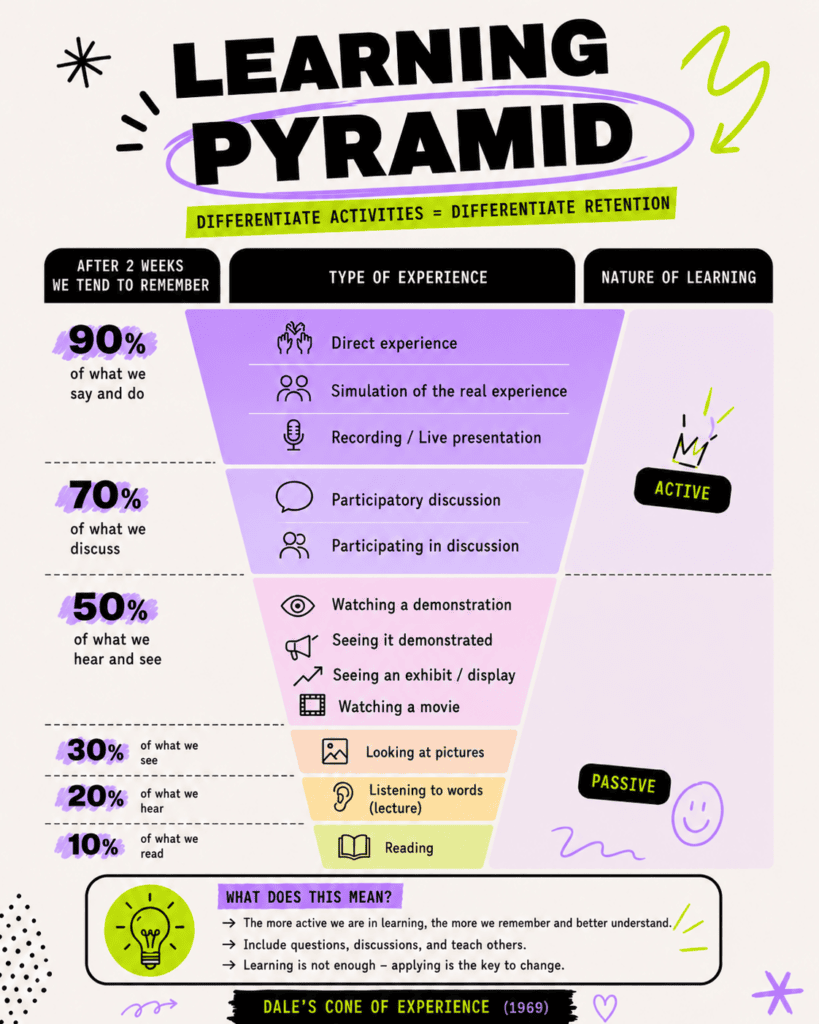
Why are exercises a core part of training?
Once we understand how people learn, it becomes clear that exercises are not a break between theoretical segments.
They are where learning actually happens.
It is only when we try to apply new knowledge that we truly see what we understand, where gaps exist, and which skills need further development. Simulations, role-plays, case studies, and discussions provide a space to experiment, make mistakes, and receive feedback in a safe environment – before facing real and more demanding business situations.
This is especially important when developing skills such as communication, leadership, negotiation, sales, or organization. These skills cannot be developed through listening alone. Just as no one can learn to drive by watching a presentation on traffic rules, business skills cannot be developed without active practice.
From learning to change
The ultimate goal of any training is not for participants to know more, but to do things differently.
Organizations do not invest in employee development so that people can memorize more facts, but because they want better communication, stronger leadership, more effective collaboration, improved problem-solving, and better business results.
The more a training is connected to real challenges participants face, and the more opportunities it provides for active application of knowledge, the more likely it is that learning will transfer into everyday work.
That is why a high-quality training is not the one where participants sit and listen. It is the one where they think, discuss, question, practice, and experiment.
Because people rarely remember what they have only heard – they remember what they have understood, experienced, and turned into their own knowledge.